reabc/Voices of the Lucasville Uprising Volume 2/Voices of the Lucasville Uprising Volume 2.pdf
Web PDF • Imposed PDF• Raw TXT (OCR)


![secure the same privileges as other condemned prisoners at Ohio State Penitentiary (OSP). ‘The call has been made by those at pelican Bay State Prison for prisoners throughout the state of California who have been suffering injustices to join them in their peaceful strike to put a stop to blatant violations of California prisoners’ civil and human rights. Moreover, their call made it perfectly clear that “if [Califoria prisoners] cannot participate in the strike, then [they should] support it in principle by not eating for the first 24 hours of the strike.” While their heartfelt plea was not made to Ohio prisoners, a growing number of us at OSP have decided to join them in their peaceful protest. We hope and pray that our united stand with those brothers at Pelican Bay will have a domino effect throughout the nation—that is, with prisoners in other states, as well as their outside supporters, will come together and stand united ‘with the oppressed soldiers at Pelican Bay. ‘Their injustices have been going on for far too long. How long? Too long! ‘Twenty-five years is t00 long for human beings to be subjected 0 the cruel terms and dictates of their oppressors. Regarding their challenges and the protracted nature of their struggle, we urge those brothas to brace themselves for the battle ahead. There will no easy victory, yet those soldiers at Pelican Bay must be determined to stay the course and to go forward in the spirit of past and present revolutionaries to change the oppressive conditions of their confinement. No matter how difficult the circumstances may become. As Comrade George L. Jackson wrote, “Revolutionary consciousness is the only real hope of those oppressed by the - Power to the oppressed People!](Voices of the Lucasville Uprising Volume 2 5.png)
![DEATH PENALTY By Sidaigue Abdullah Hasan, delivered via telephone at a Georgia tour stop of the Campaign to End the Death Penalty National Speaking Tour in 2010, Originally published in Socialist Viewpoint In the revolutionary spirit of past, present and future revolutionaries, | greet each and everyone of you in attendance with the revolutionary salute: SHIELDS UP! First and foremost, | want to thank Brotha Patrick Dyer, a good friend and comrade of mine, for inviting me to speak at this year’s Campaign to End the Death Penalty national speaking tour stop in North Georgia. Being bom and raised in the projects and war zones in Savannah, I know all t0o well about lynching and the lynch mob ‘mentality that, exist in Georgia and the surrounding states. So I have to admit, 1 am profoundly moved by the honor bestowed upon me to speak with you about this year’s theme: Lynching Then, Lynching Now. During the Fall of 2008 [October 13, 2008], Ted Koppel, an award-winning journalist and former anchorman for Nightline, hosted a television program called “The Last Lynching.” ’m not sure if any of you have seen this program or not, but this one hour special aired on the Discovery Channel, where Mr. Koppel was the managing editor. While the backdrop of the program offered a look at “how far this country has come on the racial front” and “how acts of hatred and racism have affected the lives of three Americans,” the focus was about the 1981 Iynching of Michael Donald, a 19-year-old Black man who was ‘murdered and then his limp body was hung from a tree across the street from one of the perpetrators’ apartment. The fact that most of you probably never even heard of Mr. Donald’s story and the fact that the program was incorrectly called “The Last Lynching,” I can think of no better way to begin my presentation than to begin it by narrating the story of this innocent, courageous, young man.](Voices of the Lucasville Uprising Volume 2 6.png)

![knowledge and belict, his exccution was the first time a white person was ever executed in the United States for killing a Black person, notwithstanding there is documented evidence that thousands-upon- thousands of Blacks have cither been lynched or unjustifiably murdered between the end of Reconstruction [mid-1870] and World War 11. This within itself should tell us volumes about our so-called criminal justice system and how it regards the lives of Blacks to be insignificant in comparison to others. Another reminder that our criminal justice system is broken can be seen in the fact that Blacks and whites are murdered at relatively the same rate yet 80 percent of those whom have been executed in the United States since its [the death penalty] resumption on January 17, 1977, have been executed for murdering whites, while only 13 percent have been executed for murdering Blacks. These statistics alone send a clear and alarming message to any would-be murderer: Blacks are fair game. So the question becomes: What is lynching, and does it sill exist today? According to the Establishment and their sympathizers, lynching is the process of putting someone to death by hanging—be it from a tree, bridge, tower, flagpole, or atop of a bonfire—and is executed by mob action and without legal authority. Since Ted Koppel belongs to the media Establishment, it should come as no surprise why he and his colleagues possess a narrow view as to what constitutes lynching. To accept their narrow definition is to deny that James Byrd was lynched in 1998 in Jasper, Texas, where three white men put a chain around his neck, tied it to the back of a pick up truck and then drove his body down a street until he was decapitated. Likewise, to accept their narrow definition is to deny that Amadou Diallo, Sean Bell, Tamika Wilson, Oscar Grant 11l and too many others to name, were summarily executed. No, no, no! We cannot passively accept their narrow definition when we kaow it does a disservice to humanity, and especially 1o the family members of those who were lynched. Understand and understand well, racial hatred and violence, as well as domestic terrorism, have always been the perverted ingredients that prompted the killings of innocent Blacks, Jews, ltalians, Native Americans, and other minorities in this country. As activists and revolutionaries, we have a moral and social responsibility to stand up to 8](Voices of the Lucasville Uprising Volume 2 8.png)


![their homes and jobs and are struggling to survive, and the last thing anyone wants to hear is how hard prison is for a bunch of criminals. “If you can’t do the time, don’t do the crime” is the prevailing sentiment and attitude. It never occurs that the rising incarceration rate is connected to the same cconomic and political policies that resulted in the home foreclosure erisis and the rise in unemployment. When peaple think of crime, what usually comes to mind is a poor person inflicting pain upon another poor person. Very seldom, if ever, do we stop and allow ourselves to consider the forces that create crime; trapped by the pull of our own necessities and fears, we live reactively, focusing on the effects instead of the causes of what we see and believe — and so we remain divided. And it’s precisely because of this division that we are our own worst enemies — divided, they rule us! But who are “they,” and what do they have to do with the way in which we see and treat cach other? Howard Zinn, in his book “A People’s History of the United States,” tells us who they are and how they use us against one another: “(T]he wealthiest one percent of the nation owns a third of the wealth. The rest of the wealth is distributed in such away as o tum those in the 99 percent against one another: small property owners against the propertyless, black against white, native-born against foreign-born, intellectuals and professionals against the uncducated and unskilled ...” Hence, in the context of a capitalistic society, crime is the result of an unequal distribution of wealth. As such, a distinction between guilt and responsibility must be made. For instance, a person can be guilty of selling drugs but not atall responsible for creating the conditions wherein selling drugs is the only viable option for survival. Indeed, when one lives in a society where profit takes precedence over human potential, one’s very existence becomes a crime; and whether 1](Voices of the Lucasville Uprising Volume 2 11.png)


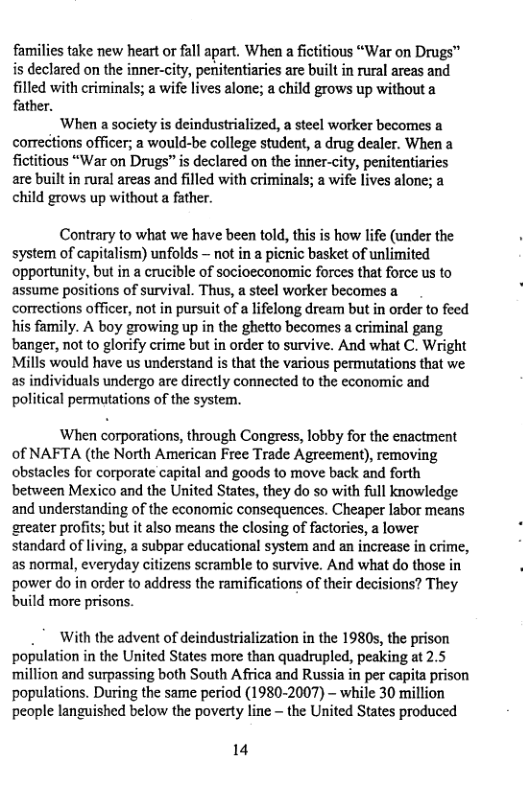


VOICES OF THE
LUCASVILLE UPRISING
VOLUME 2
TSR
CONTENTS
Greg Curry
Still Feeling the
Downpouring of Injustice 2
Siddique Abdullah Hasan
United We Stand 4
Death Penalty 3
‘Bomani Shakur
Crime and Punnishment 13
Jason Robb
Artworks 18
1
STILL FEELING THE
DOWNPOURING OF INJUSTICE
Wridten fcbruary 2006 By Greg Curry, and published on
Prisonersolidarity.org
My name is Greg Curry and 1 am a prisoner at the Ohio State
2 who loves humanity, | believe the
ly, politically, morally and cconomically--is
or justice, particularly along the lines of "race.,
4 1 male of African des
njustice even be
ent, | have felt the downpouring of
fore I could identify it. As | grow in my consciousness,
*ve comic 10 realize that White Americans need to stand on the
frontlines against racism. After all, they are the beneficiaries of bath
direct and indirect privileges, such as large inheritances, stewardships
over goveming positions, and the ability to visit arcas where Blacks
reside without being a “suspect” due to their skin tone. e cannot
ignore it any longer. This battle against racism s theirs as well as ours. |
hear a lot of talk about being a true patriot. Well, if vou're not a patriot
for humanity, you're a soldier for racism.
Human patriots must demand justice as if the victim were a child
that once played in their own backyard. a child that ence went camping
with their own children. Human patriots must seek a justice that's not
Teft to chance or circumstance. When police across America can
collectively shoot unarmed Black males, and the corporate press can
demonize the victims by releasing their criminal histories and
subliminally questioning their innocence, one knows that racism s very
much alive. True to this negative trend and stereotype of Rlack males.
1 was convicted of crimes I didn't commit during the 1993 Lucasville
uprising. As a result, | currently seek justice from false convictions. I'd
be grateful for your interest in my fight for justice.
Ceng.
WRITE TO GREG:
Greg Curry, #213-159
Ohio State Penitentiary
878 Coitsville-Hubbard Rd.
Youngstown, OH 44505
Freedom first,
UNITED WE STAND
by Imam Siddique Abdullah Hasan
Written in solidarity with the Peli
1 Bay SHU Hungerstrike, 2011
Revolutionary Salute and Shields Up! It has come to our
attention that the brothers at the Pelican Bay State Prison Security
Housing Unit will commence on indefinite hunger strike on July 1,
protest the inhumane and dehumanizing conditions they've
<ed 0 endure for 25 y Further, it is our understanding that
their protest has been inspired by the successful hunger strike that two
of my comrades and | participated in during January of this year; where
we received massive international support from those on the outside
who believed in the righteousness of our protracted struggles to fight to
4
secure the same privileges as other condemned prisoners at Ohio State
Penitentiary (OSP).
‘The call has been made by those at pelican Bay State Prison for
prisoners throughout the state of California who have been suffering
injustices to join them in their peaceful strike to put a stop to blatant
violations of California prisoners’ civil and human rights. Moreover,
their call made it perfectly clear that “if [Califoria prisoners] cannot
participate in the strike, then [they should] support it in principle by not
eating for the first 24 hours of the strike.” While their heartfelt plea was
not made to Ohio prisoners, a growing number of us at OSP have
decided to join them in their peaceful protest. We hope and pray that
our united stand with those brothers at Pelican Bay will have a domino
effect throughout the nation—that is, with prisoners in other states, as
well as their outside supporters, will come together and stand united
‘with the oppressed soldiers at Pelican Bay.
‘Their injustices have been going on for far too long. How long?
Too long!
‘Twenty-five years is t00 long for human beings to be subjected
0 the cruel terms and dictates of their oppressors.
Regarding their challenges and the protracted nature of their
struggle, we urge those brothas to brace themselves for the battle ahead.
There will no easy victory, yet those soldiers at Pelican Bay must be
determined to stay the course and to go forward in the spirit of past and
present revolutionaries to change the oppressive conditions of their
confinement. No matter how difficult the circumstances may become.
As Comrade George L. Jackson wrote, “Revolutionary consciousness is
the only real hope of those oppressed by the -
Power to the oppressed People!
DEATH PENALTY
By Sidaigue Abdullah Hasan, delivered via telephone at a Georgia tour
stop of the Campaign to End the Death Penalty National Speaking Tour
in 2010, Originally published in Socialist Viewpoint
In the revolutionary spirit of past, present and future
revolutionaries, | greet each and everyone of you in attendance with the
revolutionary salute: SHIELDS UP!
First and foremost, | want to thank Brotha Patrick Dyer, a good
friend and comrade of mine, for inviting me to speak at this year's
Campaign to End the Death Penalty national speaking tour stop in North
Georgia. Being bom and raised in the projects and war zones in
Savannah, I know all t0o well about lynching and the lynch mob
‘mentality that, exist in Georgia and the surrounding states. So I have to
admit, 1 am profoundly moved by the honor bestowed upon me to speak
with you about this year’s theme: Lynching Then, Lynching Now.
During the Fall of 2008 [October 13, 2008], Ted Koppel, an
award-winning journalist and former anchorman for Nightline, hosted a
television program called “The Last Lynching.” 'm not sure if any of
you have seen this program or not, but this one hour special aired on the
Discovery Channel, where Mr. Koppel was the managing editor. While
the backdrop of the program offered a look at “how far this country has
come on the racial front” and “how acts of hatred and racism have
affected the lives of three Americans,” the focus was about the 1981
Iynching of Michael Donald, a 19-year-old Black man who was
‘murdered and then his limp body was hung from a tree across the street
from one of the perpetrators’ apartment. The fact that most of you
probably never even heard of Mr. Donald’s story and the fact that the
program was incorrectly called “The Last Lynching,” I can think of no
better way to begin my presentation than to begin it by narrating the
story of this innocent, courageous, young man.
Mr. Donald was murdered in Mobile, Alabama, by Henry
Francis Hays and James “Tiger” Knowles, two members of the Ku Klux
Klan.
The Ku Klux Klan in Southern Alabama had met that week and
discussed the fact that a Black man was on trial in Mobile, accused of
shooting a White police officer. The members of the Klan. including
Hays and Knowles, felt that there was a risk that the killer would be
acquitted and they were very concerned that a Black man would be able
to get away with killing a White police officer.
Ultimately on Friday evening, the jury reported it was unable to
reach a verdict since it was “hung.” Infuriated and fueled by that, Hays
and Knowles borrowed 15 feet of rope from Hays' brother-in-law and
‘went out looking for a target to lynch or “harass.” Notice. included is
the word “harass,” because some people were of the opinion that the
perpetrators only wanted to frighten someone. Anyway, they took Mr.
Donald to the middle of a pine forest. The branches on the pine trees
were at least 20 feet above the ground so they realized there was no way
they could throw the rope over the branch and hang their intended
victim, Nonetheless, as they pointed the gun at Mr. Donald. he
courageously fought back and ultimately managed to seize the pistol. At
that point the two tackled him, knocked him unconscious, went to the
trunk of the car and got the rope, placed it around his neck and choked
him to death. Afterward, they put his limp body in the trunk and then
drove around Mobile trying to figure out what to do with the body.
They finally decided to hang it from a tree across the street from where
Hays lived.
In spite of it being hung just across the street from where 2
known racist and member of the KKK lived, amazingly. it was two
years before the FBI was able to develop evidence which led them to
Knowles, who ultimately cooperated in the prosecution of his co-
defendant, Henry Hays.
Hays was convicted of capital murder and was eventually
executed for his part in this senseless crime. In fact. to the best of my
7
knowledge and belict, his exccution was the first time a white person
was ever executed in the United States for killing a Black person,
notwithstanding there is documented evidence that thousands-upon-
thousands of Blacks have cither been lynched or unjustifiably murdered
between the end of Reconstruction [mid-1870] and World War 11. This
within itself should tell us volumes about our so-called criminal justice
system and how it regards the lives of Blacks to be insignificant in
comparison to others. Another reminder that our criminal justice system
is broken can be seen in the fact that Blacks and whites are murdered at
relatively the same rate yet 80 percent of those whom have been
executed in the United States since its [the death penalty] resumption on
January 17, 1977, have been executed for murdering whites, while only
13 percent have been executed for murdering Blacks. These statistics
alone send a clear and alarming message to any would-be murderer:
Blacks are fair game.
So the question becomes: What is lynching, and does it sill exist
today?
According to the Establishment and their sympathizers, lynching
is the process of putting someone to death by hanging—be it from a
tree, bridge, tower, flagpole, or atop of a bonfire—and is executed by
mob action and without legal authority. Since Ted Koppel belongs to
the media Establishment, it should come as no surprise why he and his
colleagues possess a narrow view as to what constitutes lynching. To
accept their narrow definition is to deny that James Byrd was lynched in
1998 in Jasper, Texas, where three white men put a chain around his
neck, tied it to the back of a pick up truck and then drove his body down
a street until he was decapitated. Likewise, to accept their narrow
definition is to deny that Amadou Diallo, Sean Bell, Tamika Wilson,
Oscar Grant 11l and too many others to name, were summarily
executed. No, no, no! We cannot passively accept their narrow
definition when we kaow it does a disservice to humanity, and
especially 1o the family members of those who were lynched.
Understand and understand well, racial hatred and violence, as
well as domestic terrorism, have always been the perverted ingredients
that prompted the killings of innocent Blacks, Jews, ltalians, Native
Americans, and other minorities in this country. As activists and
revolutionaries, we have a moral and social responsibility to stand up to
8
evil and change the course of history. It shouldn’t matter if the
perpetrators or facilitators of these Iynchings are Klans, cops. judges or
even govemors, nor should it matter if the lynchings are done via a
rope, gun, lethal injection or an electric chair. In the end, a lynching is
still a lynching—plain and simple. Our predecessors, both Blacks and
‘whites, fought against lynching and we should send a clear message that
we will fight against it today.
In conclusion, I want to remind you that to be a revolutionary is
to be an agent of change, which is virtually impossible to achieve if one
doesn’t know what needs to be changed. I also want to remind you that
in this past presidential election, this country voted for change and
Barack Obama promised it. Therefore, we shauld hold him accountable
o his promise. As a revolutionary, I urge you to continue with your
fight to save the lives of Troy Anthony Davis, Mumia Abu-Jamal, and
the other innocent men and women on death row waiting (o be lynched.
From death row, this is Siddique Abdullah Hasan
{
/Imam Siddiqu= 'Abdullah
Ohio Stztz Panitent
WRITE TO HASAN:
siddique Abdullah Hasan
R150-559
Ohio State Penitentiary
878 Coitsville-Hubbard rd
Youngstown, OH 44505-4635
CRIME AND PUNNISHMENT
By Boraani Shakur, December 2011
“The degree of civilization in a society can be judged by
entering its prisons.”- Dosioyevsky
11 what Dostoyevsky says is true - and | believe it is ~ then
America, which boasts the largest prison population in the world, is
pertiaps e most uacivilized country there is. A bold statement, I know,
especially comning from someone who has spent the past 23 years
beliind bass. But if what Dostoyevsky says i true, then what happens
inside thesc places is crucial 10 understanding what kind of sociely we
live in; and who better t0 speak 1o the reality of prison life than
someonc who is living the experience?
But 00 one wants to learn about the madness that predominates
nside these places. People - average, law-abiding citizens ~ are losing
10
their homes and jobs and are struggling to survive, and the last thing
anyone wants to hear is how hard prison is for a bunch of criminals. “If
you can’t do the time, don’t do the crime” is the prevailing sentiment
and attitude. It never occurs that the rising incarceration rate is
connected to the same cconomic and political policies that resulted in
the home foreclosure erisis and the rise in unemployment.
When peaple think of crime, what usually comes to mind is a
poor person inflicting pain upon another poor person. Very seldom, if
ever, do we stop and allow ourselves to consider the forces that create
crime; trapped by the pull of our own necessities and fears, we live
reactively, focusing on the effects instead of the causes of what we see
and believe — and so we remain divided. And it's precisely because of
this division that we are our own worst enemies — divided, they rule us!
But who are “they,” and what do they have to do with the way in
which we see and treat cach other?
Howard Zinn, in his book “A People’s History of the United
States,” tells us who they are and how they use us against one another:
“(T]he wealthiest one percent of the nation owns a third
of the wealth. The rest of the wealth is distributed in such
away as o tum those in the 99 percent against one
another: small property owners against the propertyless,
black against white, native-born against foreign-born,
intellectuals and professionals against the uncducated
and unskilled ...”
Hence, in the context of a capitalistic society, crime is the result
of an unequal distribution of wealth. As such, a distinction between
guilt and responsibility must be made. For instance, a person can be
guilty of selling drugs but not atall responsible for creating the
conditions wherein selling drugs is the only viable option for survival.
Indeed, when one lives in a society where profit takes precedence over
human potential, one’s very existence becomes a crime; and whether
1
this takes on the form of selling drugs, stealing food ot joining a gang to
fight over turf and limited resources, the goal is to stay alive.
‘When one lives in a society where profit takes precedence over
human potential, one’s very existence becomes a crime; and whether
this takes on the form of selling drugs, stealing food or joining a gang to
fight over turf and limited resources, the goal is to stay alive.
1 grew up in poverty, bon to a marginally educated Black
woman who, because of a lack of opportunity, sought to raise me and
my three siblings on welfare. In the whole 42 years I've been alive, I've
only seen my father one time. By the age of 10, I was stealing food from
the neighborhood grocery store in order to survive. 1 was 13 when I
took my first joyless joyride in a stolen vehicle, which ultimately led to
my being sent away for the first time. By the time I tumed 17, I had
been living on my own for several years and selling drugs in one of the
‘most impoverished, drug-infested neighborhoods in Cleveland, Ohio. A
few months after my 19th birthday, in 1988, the year crack cocaine
became an epidemic, | was involved in a shoot-out over money and I
killed a rival drug dealer. For this, | was sent to prison to serve a life
sentence for murder.
In a nutshell, this s the story of my life, and if any of it was
unique, the telling of it would be inconsequential, an unnecessary
recounting of my own personal troubles. However, what makes my
story significant is that it’s the exact same tale told by millions of poor
people who grow up in the slums of America, which points to the
possibility of there being something larger than one’s personal troubles
at work in the process to determine where one ends up in this society.
In his groundbreaking work on “The Sociological Imagination,”
C. Wright Mills. using the example of unemployment, explains the
diffefence between personal troubles and societal issues:
“When, in a society of 100,000, only one man is
unemployed, that s his personal trouble, and for its relief
we properly look to the character of the man, his skills,
and his immediate opportunities. But when in a nation of
12
50 million employees, 15 million men are unemployed,
that is an issue, and we may not hope to find its solution
within the range of opportunities open 1o any one
individual. The very structure of opportunities has
collapsed. Both the correct statement of the problem and
the range of possible solutions require us to consider the
economic and political institutions of society, and not
merely the personal situation of a scatter of individuals.”
Applying the same logic, it should be considered an issue that
Black people - in a country wherein they represent only 13 percent of
the population ~ make up 50 percent of those who are sent to prison. It
is likewise an issue that virtually 100 percent of those behind bars are
poor and come from economically deprived sections of society.
In addressing this issue, it's not enough to point the finger at a
bunch of so-called criminals and, without first looking at the economic
and political institutions of society, claim that they are the sole cause of
their predicament.
Despite what those in power would have s believe, no one
starts out with the goal of becoming a criminal and spending the bulk of
his life behind bars and in‘and out of prison. As individuals, we make
choices based on what we perceive our options to be; and those options,
be they good or bad, are a product of the society we live in.
“When a society is industrialized,” explains C. Wright Mills, “a
peasant becomes a worker; a feudal lord is liquidated or becomes a
businessman. When classes rise and fall, a man is employed or
unemployed; when the rate of investment goes up or down, a man takes
new heart or goes broke. When wars happen, an insurance salesman
becomes a rocket launcher; a store clerk, a radar man; a wife lives
alone; a child grows up without a father.”
Similarly, when a society is deindustrialized, a steel worker
becomes a corrections officer; a would-be college student, a drug
dealer. When communities are decimated and hemmed in by poverty,
13
families take new heart or fall apart. When a fictitious “War on Drugs”
is declared on the inner-city, penitentiaries are built in rural areas and
filled with criminals; a wife lives alone; a child grows up withouta
father.
‘When a society is deindustrialized, a steel worker becomes a
corrections officer; a would-be college student, a drug dealer. When a
fictitious “War on Drugs” is declared on the inner-ity, penitentiaries
are built in rural areas and filled with criminals; a wife lives alone; a
child grows up without a father.
Contrary to what we have been told, this is how life (under the
system of capitalism) unfolds - not in a picnic basket of unlimited
opportunity, but in a crucible of socioeconomic forces that force us to
assume positions of survival. Thus, a steel worker becomes a
corrections officer, not in pursuit of a lifelong dream but i order to fecd
his family. A boy growing up in the ghetto becomes a criminal gang
banger, not to glorify crime but in order to survive. And what C. Wright
Mills would have us understand is that the various permutations that we
as individuals undergo are directly connected to the economic and
political permutations of the system.
When corporations, through Congress, lobby for the enactment
of NAFTA (the North American Free Trade Agreement), removing
obstacles for corporate capital and goods to move back and forth
between Mexico and the United States, they do so with full knowledge
and understanding of the economic consequences. Cheaper labor means
greater profits; but it also means the closing of factories, a lower
standard of living, a subpar educational system and an increase in crime,
as normal, everyday citizens scramble to survive. And what do those in
power do in order to address the ramifications of their decisions? They
build more prisons.
With the advent of deindustrialization in the 1980, the prison
population in the United States more than quadrupled, peaking at 2.5
million and surpassing both South Africa and Russia in per capita prison
populations. During the same period (1980-2007) ~ while 30 million
people languished below the poverty line — the United States produced
14
1,000 billionaires and 227,000 millionaires with the combined worth of
$30 willion, more than the GDPs of China, Brazil, Japan, Russia and the
EU put together. This is how the system of capitalism works: The rich
get richer, and the poor get screwed - i.c., fucked in the anus sans
grease!
In his book “Understanding Power,” Noam Chomsky talks about
what he refers to as “superfluous populations,” which s a very
intellectual way of calling people “trash.” From the perspective of the
rich, whose main objective is to accumulate wealth, human beings are
useless when they no longer contribute to profit-making so, as a result,
explains Noam Chomsky, they want to get rid of them — and the
criminal justice system is one of the best ways of doing it
So prisons — it must be understood aren’t about controlling
crime and punishing those who commit it theyre about controlling the
poor. Looked at correctly, it's not an exaggeration to say that what is
going on now is very similar to what was going on in the 19405 when
Hitler was exterminating the Jews. The only real difference is that those
who are now being thrown away are considered “criminals” which, let’s
face it, makes it a whole lot casier to accept. But just as Hitler created
the justification for the mass extermination of the Jews, 5o, too, have
those in power created the justification for the mass incarceration of the
poor.
When Ronald Reagan declared the so-called War on Drugs in
the 1980s, a finely honed strategy of imposing mandatory sentences for
particular kinds of drugs (read: crack cocaine) was used to lock up those
from predominantly Black and Hispanic communities. For instance, a
young man in the ghetto gets caught with a kilo of cocaine or $20,000 in
cash, and he is sent to prison for 20 years. In the meaatime, nothing is
said about the chemical corporations who make billions of dollars from
sending the necessary chemicals to Latin America in order to
‘manufacture the very drugs that are destroying inner-cities throughout
the United States.
15
And what about the bankers who launder billions of dollars in
drug money through American banks? According to the OECD
(Organization for Economic Cooperation and Development),it's
estimated that half-trillion dollars in drug money gets laundered
internationally each year ~ more than half of it (5260 billion) through
American banks. But are any of these people in prison? The answer is
NO! And the reason why none of these people are in prison is because
those in power determine what constitutes a crime and, more
importantly, who gets categorized as criminals. A white man laundering
billions of dollars in drug money is a businessman. A Black man selling
drugs in the ghetto is a criminal; and for his “crimes,” he is sent to
prison.
And what happens to that Black - or poor White or Hispanic —
man when he enters America’s prisons? If he makes it through
orientation without being raped, he's lucky. It's a brutal world in here,
and unless one is totally devoid of common sense, one very quickly
leams that there is safety in numbers. In other words, the picture repeats
and expands, and it’s the ghetto streets all over again. But in here the
police operate without restraint, and the old adage about “absolute
power corrupting absolutely” is on full display. Not a day goes by
without someone being sprayed in the face with mace, shot with a pellet
gun o thrown down a flight of stairs.
Those in power determine what consfitutes a crime and who gets
categorized s criminals. A white man laundering billions of dollars in
drugmoney is a businessman. A Black man selling drugs in the ghetto
is a criminal; and for his “crimes,” he is sent to prison.
A few weeks ago, while watching the news, | witnessed a group
of college students in Califoria being sprayed in the face with mace
because they had the audacity to protest against the rising cost of
college tuition, student-loan debt and the uncertainty surrounding future
employment. In New York City and around the country, I witnessed
members of Occupy Wall Street being forcibly evicted from their
camps, some - as in Oakland, California — being shot with pellet guns,
thrown atop automobiles, and kicked and shoved about like cattle. .
16
Watching these things, it occurred to me that this is what Dostoyevsky
must have meant when he said, “The degree of civilization in a society
can be judged by entering its prisons.” Indeed, what many Amer
witnessed and experienced for the first time is something that those of
us in prison witness and experience on a daily basis
So why are normal, everyday citizens being treated as criminals,
and for what crimes are they being punished? From the perspective of
those who own society, it’s considered a lack of appreciation when
slaves rise up to question their masers; and of course when people
come together and begin t0 talk eamnestly about the inequity of the
system, they automatically represent a threat to the status quo and must
20. Then we leam how thin the vencer of civilization really is, and how
fragile our so-called freedoms arc.
When eyes are burning with mace, when blood is dripping down
the face, it all becomes frighteningly clear: Capitalism is a sham; and
whether in or out of prison, as long as we live under a system that views
everything and everybody as a commodity, we're all doing time. And
that, at the end of the day, is the real crime ~ not that some of us are
locked up, but that none of us are free!
ot //
i omar
AT
/" Bomani Shakur
December 2011
WRITE TO BOMANI :
Lamar 317-117
Ohio State Penitentiary
878 Coitsville-Hubbard Rd
Youngstown OH 44505-4635
17
ART BY JASON ROBB
WRITE TO JASON ROEB
Jason Robb 308-319
Ohio State Penitentiary
878 Coitsville-Hubbard Rd
Youngstown OH 44505-4635
19
Lucasville Uprising was a rebellion against oppressive
and racist policies at the Southern Ohio Correctional
Facility (SOCF) in Lucasville, OH. Nine inmates and ome
d died during the uprising in April of 1993. Today,
people are serving time or condemned to death by the
state of Ohio in relation to the uprising. We demand
amnesty and freedom for all of these inmates. The
conditions at SOCF were (and still are) intolerable and
unconscionable msouth Chicago ABC
Zine Distro
REDBI Gl e
" BOORr 2040
PRI S O Columbus Oh 43216
redbirdprisonabolition.org
The distributors this zine do not support the various
alleged affiliations of the prisoner contributors to this
. but strongly support their stand against government
n, and will do what we can to amplify their
s’ shown by prisoner resistance nationally there
ed for to look past individual beliefs and alleged
ons, to stand together. Unity takes away the
their captors to play puppet masters and places
Dower back to those enlightened prisoners who choose hot
© be puppets. These prisoners' united stand across
1le: divisions and under the most trying of
circumstances should be an example and inspiration to us
all.
FREE ALL PRISONERS
distributed by: